The Sith Empress
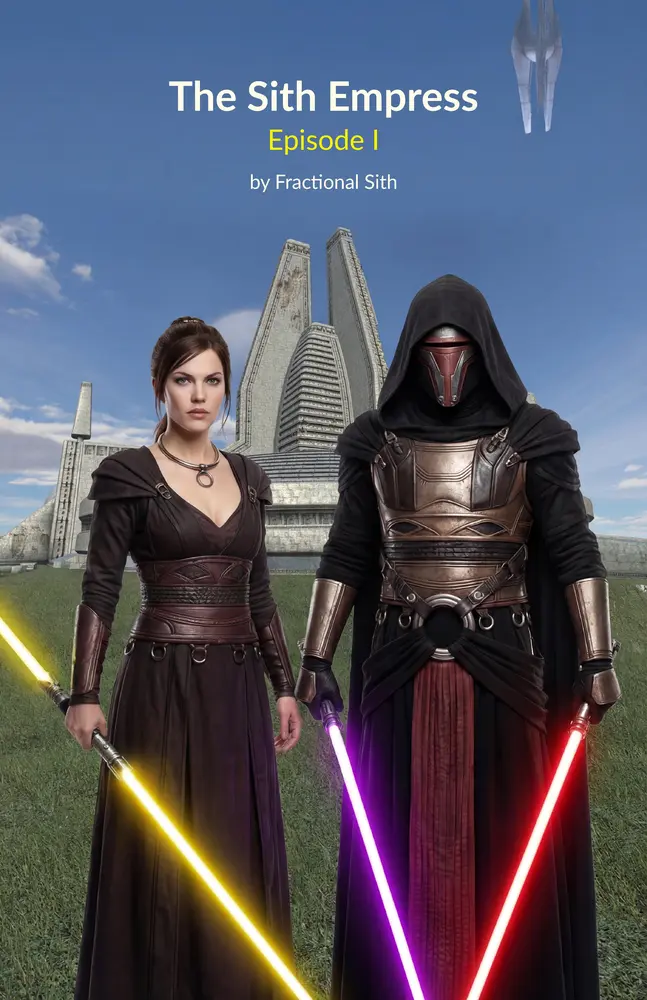
The Sith Empress is an alternative take on Star Wars: Knights of the Old Republic, with dark side male Revan as the dominant partner in a BDSM relationship with a submissive Bastila, where they seize control of the Sith back from Malak to free the galaxy from the corruption of the Republic and bring about their vision of a better galaxy.
The story is divided into episodes:
Foreword
Atop the summit of the Temple of the Ancients, Bastila expressed her disdain at bowing to the Jedi Masters and calling them “Master,” yet she does the same to Revan willingly and happily. In fact, this is what she says:
I need deny my passions no longer, Revan. I would stand by your side gladly, as your lover and apprentice! I swore allegiance to Malak only because I thought you had lost the power you had once wielded. But this… this would be much better. I would be utterly yours, master! Together we would destroy Malak and you would reclaim the mantle of Dark Lord!
What exactly did Bastila have in mind when declaring herself utterly Revan’s should he join her? Why did she save Revan’s life when she was perfectly content with leaving someone to die in the Dune Seas on Tatooine? She clearly doesn’t save people out of the goodness of her heart. Why was Revan so special to Bastila? Perhaps there is a forgotten past between the two. This story explores an interesting possibility for their past: a BDSM power exchange relationship.
For this background to make any difference in the story line, Revan must remember the past. Otherwise, little would change. And if he remembers, there is little reason to expect him to not continue with his original goals. This poses a bit of a problem, as the explanation of his actions in the subsequent works proves too flimsy.
For Revan to walk his own path, he must have a good reason for his actions, and supposed mind control by external parties just doesn’t cut it. Bastila would hardly, out of her own free will, continue to surrender her control completely to a person who has proved to be vulnerable to manipulation. And besides, even if Revan was conquering the galaxy in hopes of making it stronger against a hidden threat, he would still have needed a just cause to champion, and he also would not have left in the aftermath of his triumph to let his hard work fall into chaos. And thus, a better explanation was needed—not an insanely overpowered villain, a diabolus ex machina introduced later to make the Jedi look wise and good.
In contrast to the later works that blatantly favour the Jedi, Star Wars: Knights of the Old Republic gives plenty of reasons to dislike the Jedi just as it did for the Sith under Malak. It was meant to offer a true choice, and the decisions you can make in game reflect that. Most choices in the game are independent and you have the freedom to do exactly what you feel is right in any given situation, and you are free to make the final decision that decides the fate of the galaxy either way, regardless of anything else you do in the game or your character’s alignment.
Through the lens of KotOR, we can see the many questionable actions of the Jedi. Even strongly pro-Republic characters like Carth call them out: leaving the Republic and its citizens to burn, the cruel training of Juhani that caused the death of innocent civilians, and the Order’s indifference to slavery when it is outside their mandate. Yet, the Jedi Order remains firm in the belief that they could do no wrong. In many ways, it is clear that they are a cult that indoctrinates its members which they recruit (if not kidnap) as young as possible, allowing them to only see their twisted version of the supposed truth. In the same vein, the claim that Revan was somehow corrupted and the Jedi did him a favour wiping his mind was a later invention to justify the actions of the Jedi, because they are supposed to be the good guys and cannot be seen to do wrong.
Likewise, the Republic supposedly embodies freedom and democracy, and the Sith violence and oppression. Yet, HK-47’s experience with the senator paints a picture of corruption in the very fabric of the state. If the very leaders of the Republic rising to power through ruthless murders was business as usual, then any supposed freedom or democracy was nothing but a façade.
Clearly, this is a sign that histories are being written by the victors, and they no doubt tried their best to sugarcoat their actions… if not outright forge history. But if the Republic and Jedi are corrupt and do not represent good, then who does? In KotOR, we see Revan as a hero who fought against the Mandalorians to protect the galaxy. What if he never actually turned evil, but instead, championed a righteous cause that put him on a collision course with the Republic and the Jedi?
In this story, Revan remembers himself instead of the lies he was programmed to believe. With Bastila by his side, he shall restore himself to the Sith throne, purge the influence of Malak the usurper, and return the Sith to a force of good. In the end, he shall be a great emperor of old, sweeping away the dysfunctional and corrupt remains of a Republic that served only the rich and powerful. He found a galaxy of brick, and shall leave it of marble. We shall explore the military and political strategy and the difficult decisions that must be made on the path to victory and the creation of a free and just society.